


Last Updated: October 28, 2026
Quick Summary
To brew premium tea at home, start with loose leaves, fresh cold water heated once, and a digital thermometer, scale and timer. Use roughly 2 to 3 grams of leaves per 250 ml cup, match water temperature and steeping time to your tea type, then taste and adjust from that known starting point.
- Weigh leaves once or twice per tea so you learn what a proper scoop looks like.
- White and green teas brew at 75-85°C, while herbal tea needs 95-100°C.
- Start with the shortest steeping time in the range, taste, then add more time.
- Store leaves airtight, away from sunlight, in a cool cupboard rather than above the stove.
- For gongfu-style brewing, start with 5-7 g per 150 ml and keep the first steep very brief.
Table of Contents
- What You'll Need to Brew Premium Tea at Home
- Step 1: Choose Your Leaves and Start With Fresh Water
- Step 2: Get Your Tea-to-Water Ratio Right
- Step 3: Follow a Tea Brewing Temperature Chart
- Step 4: Nail Your Loose Leaf Tea Steeping Time
- Step 5: Strain, Serve and Re-Steep
- How to Store Loose Leaf Tea So It Stays Fresh
- Common Brewing Mistakes and How to Fix Them
- Frequently Asked Questions
What You'll Need to Brew Premium Tea at Home
Great tea starts with four things: good leaves, fresh water, the right temperature, and timing you can repeat. This guide walks you through how to brew premium tea at home, step by step.
Here's the honest truth most guides skip: expensive leaves can still make a bitter cup. Technique matters as much as the tea itself.
You don't need a cabinet full of gadgets. You need a few reliable tools and a little attention.
The Equipment That Actually Matters
A digital thermometer can help you measure water temperature.
A simple scale that reads in grams can help you measure tea leaves.
Then an infuser or a small teapot with a built-in strainer. Loose-leaf tea needs room to expand, and a cramped basket blocks that.
Skip the rest for now. Fancy kettles with preset buttons are nice, but a thermometer and a timer on your phone do the same job.
| Tool | Why It Matters | Skip If |
|---|---|---|
| Digital thermometer | Controls water temperature precisely | Your kettle has accurate presets |
| Kitchen scale (grams) | Makes leaf measurement repeatable | You always brew the same tea and know your scoop |
| Infuser or strainer pot | Gives leaves room to expand | You use a gaiwan or brew in a mug with a basket |
| Timer | Prevents over-steeping | You consistently watch the clock anyway |
Step 1: Choose Your Leaves and Start With Fresh Water
Pick a tea you're excited to drink. Loose-leaf tea is one option to explore.
If you're new to loose leaf, start with something forgiving. A floral green tea like jasmine is a gentle entry point. If you like a classic cup with milk, an Earl Grey is an easy, familiar choice.


Why Water Quality Changes Everything
Water is most of your cup.
Fresh, cold water heated once gives you the cleanest base. That single habit improves cheap tea and premium tea alike.
Step 2: Get Your Tea-to-Water Ratio Right
The tea-to-water ratio is the weight of dry leaves compared to the volume of water. A starting point is roughly 2 to 3 grams of leaves per 250 ml cup.
Why Weight Beats Volume
Leaves can vary in size and density.
Weigh your leaves once or twice per tea, and you will learn what a proper scoop looks like for that specific leaf. After that, you can eyeball it with confidence, but the scale is what teaches your eye.
A Practical Ratio Guide by Tea Type
- White tea: 3-4 g per 250 ml. White leaves are bulky and light, so you need more volume to reach the same weight.
- Green tea: 2-3 g per 250 ml. Start low; green tea turns bitter quickly when over-leafed.
- Oolong tea: 3-5 g per 250 ml. Rolled oolong is dense, so a small scoop goes a long way. Start at 3 g and increase for a fuller cup.
- Black tea: 2.5-3 g per 250 ml. Black tea is forgiving on ratio but punishes over-steeping more than over-leafing.
- Herbal tea: 3-5 g per 250 ml. Herbal blends vary widely; dense roots and barks need more weight than airy flowers.
Adjusting for Your Cup and Method
For gongfu-style brewing, which uses a high leaf-to-water ratio and many short infusions, start with 5-7 g per 150 ml and expect the first steep to be very brief. That method is covered later in this guide, but the ratio principle is the same: weigh the leaves, measure the water, and adjust from a known starting point.
Step 3: Follow a Tea Brewing Temperature Chart
A tea brewing temperature chart can be a reference when preparing tea.
- White tea: 75-80°C
- Green tea: 75-85°C
- Oolong tea: 85-90°C
- Black tea: 90-95°C
- Herbal tea: 95-100°C
If you want to explore matcha, our matcha is crafted for traditional preparation.

Step 4: Nail Your Loose Leaf Tea Steeping Time
Loose leaf tea steeping time is the clock that decides whether your cup tastes sweet or sharp. Start with the shortest time in the range, taste, and add more time if you want a stronger brew.
Brewing Times by Tea Type
- White tea: 2-3 minutes
- Green tea: 2-3 minutes
- Oolong tea: 3-4 minutes
- Black tea: 3-5 minutes
- Herbal tea: 5-7 minutes
A 2016 study in PubMed Central on brewing time and tea antioxidants found that brewing time affects antioxidant activity and polyphenol content. In plain terms: how long you steep changes what ends up in your cup.
Our Earl Grey listing recommends steeping for 5-10 minutes at 195°F and using 2.5 g per 12 oz.
Step 5: Strain, Serve and Re-Steep
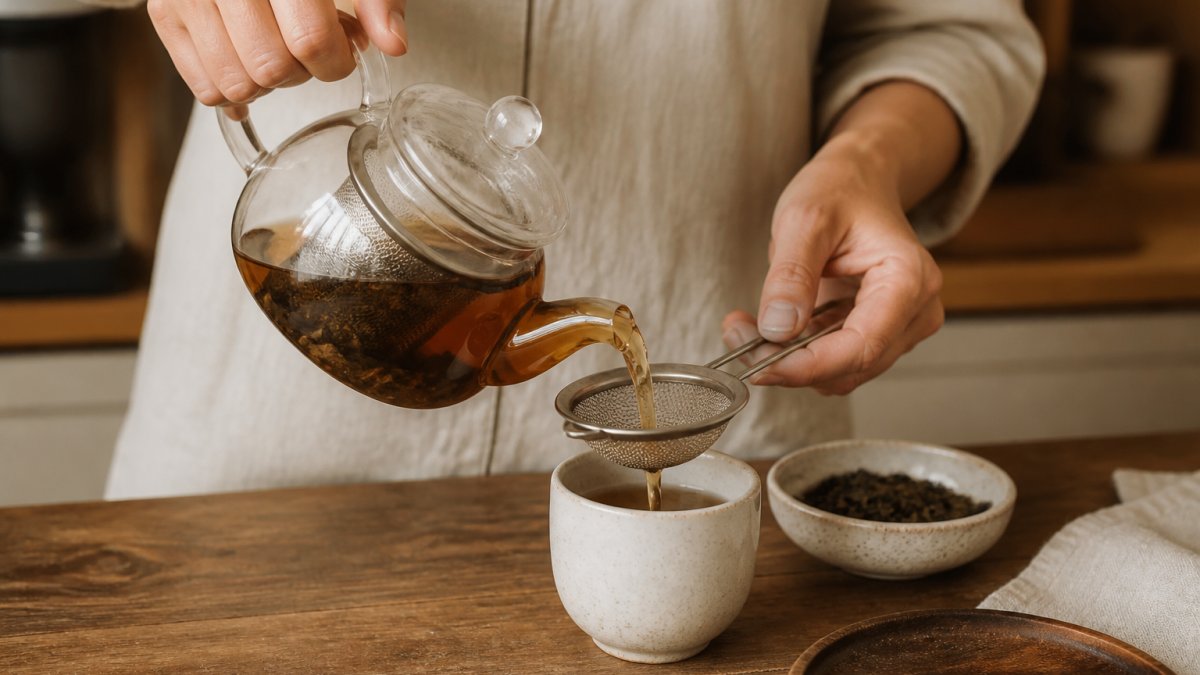
Our Jasmine is suitable for multiple steepings.
How to Store Loose Leaf Tea So It Stays Fresh
Air, light, heat, and moisture are the four enemies of fresh tea. Store your leaves in an airtight container, away from sunlight, in a cool cupboard rather than above the stove.
If you're storing tea to give as a gift, ready-made sets take the guesswork out of it. Our premium tea gift sets to order online are packed for sharing.
Common Brewing Mistakes and How to Fix Them
Most brewing problems show up in the cup before you know what caused them. This section is a symptom-to-fix guide: find what your tea tastes like, then work backward to the likely cause. It is the fastest way to improve without buying new gear or new leaves.
Bitter or Astringent Tea
- **
- **
- Too many leaves: If the cup is bitter but also thin, you may have over-leafed a delicate tea. Reduce the leaf weight by about a gram and try again.
Weak or Watery Tea
- **
- **
- Consider freshness: Stale leaves taste flat no matter how you brew them. If the dry leaf smells dull or papery, the problem is storage, not technique.
Flat or Dull Aroma
- **
- **
- Check storage: Leaves stored near spices or in a warm cupboard absorb odors and lose their top notes. Airtight, dark, and cool is the standard.
Cloudy or Off-Flavor Cup
- **
- Try a different water: Hard water can make tea look cloudy and taste flat. If filtered water changes the cup, your tap water was the issue.
Inconsistent Results
- **
- **
- **
Once you have dialed in your leaves, water, temperature, and time, the process becomes second nature. If you want to fine-tune for personal taste, Plum Deluxe's guidance on adjusting steeping strength is a useful next step.
Frequently Asked Questions
What is the correct way to brew premium tea at home?
Start with fresh, filtered water and heat it to the right temperature for your tea type, generally 160-180°F for green and white teas and 195-212°F for black and oolong. Measure roughly 2.5 g of loose leaf per 12 oz of water, steep for the recommended time, then remove the leaves. The 2016 study in PubMed Central found brewing time and technique affect antioxidant and polyphenol levels, so timing matters for both flavor and what you get from the cup.
How much loose-leaf tea should I use per cup?
A reliable starting point is 2.5 g of loose leaf per 12 oz of water, which is close to one rounded teaspoon for most teas. Dense leaves like sencha or fine oolong need less volume to hit that weight, while bulky white tea or herbal blends need more. A small kitchen scale removes the guesswork and keeps your tea-to-water ratio consistent from cup to cup.
Can you steep loose-leaf tea more than once?
Gone to the Dogs Jasmine is described as suitable for multiple steepings.
Does the quality of water affect the taste of tea?
It does. Tea is mostly water, so chlorine, heavy mineral content or stale water from a kettle reheated repeatedly will show up in the cup. Use freshly drawn filtered water each time and avoid water that has boiled down and concentrated its minerals. Soft, clean water lets the leaf's aroma and flavor come through instead of masking it.
Brewing a truly good cup at home comes down to a few small habits: fresh water, weighed leaves, the right temperature, and a timer you trust. At Gone to the Dogs, we source premium teas and freshly roasted coffee for people who care about the difference. Explore our loose-leaf range, from fragrant jasmine to bold masala chai, and make every cup worth savoring. Get started with Gone to the Dogs and turn your daily tea ritual into the best part of your morning.


